
What is somatic movement? Moving through what words can't reach
Somatic movement is one of those phrases that keeps drawing people in without ever quite explaining itself. My read is that it names something a lot of us are missing: permission to move without being evaluated.
At its simplest, somatic movement is movement practiced with your attention on the internal experience rather than the external shape. What makes it interesting is not the technique itself. It is what becomes available when nobody, including you, is grading the result.
I want to give you a clear picture of what somatic movement is, what it actually looks like in practice, what it can honestly offer, and where I think the popular version of it goes too far.
In case you are new here, I am Danielle Wiggins, and my practice is rooted in somatic psychotherapy, movement, and embodied practice. I support reflective adults who understand themselves well and still feel far from their own bodies. Dance and movement were how I survived my own early life long before they became part of my clinical training. I come to this work with a deep respect for what movement can make possible. I also will not oversell it to you.
What is somatic movement?
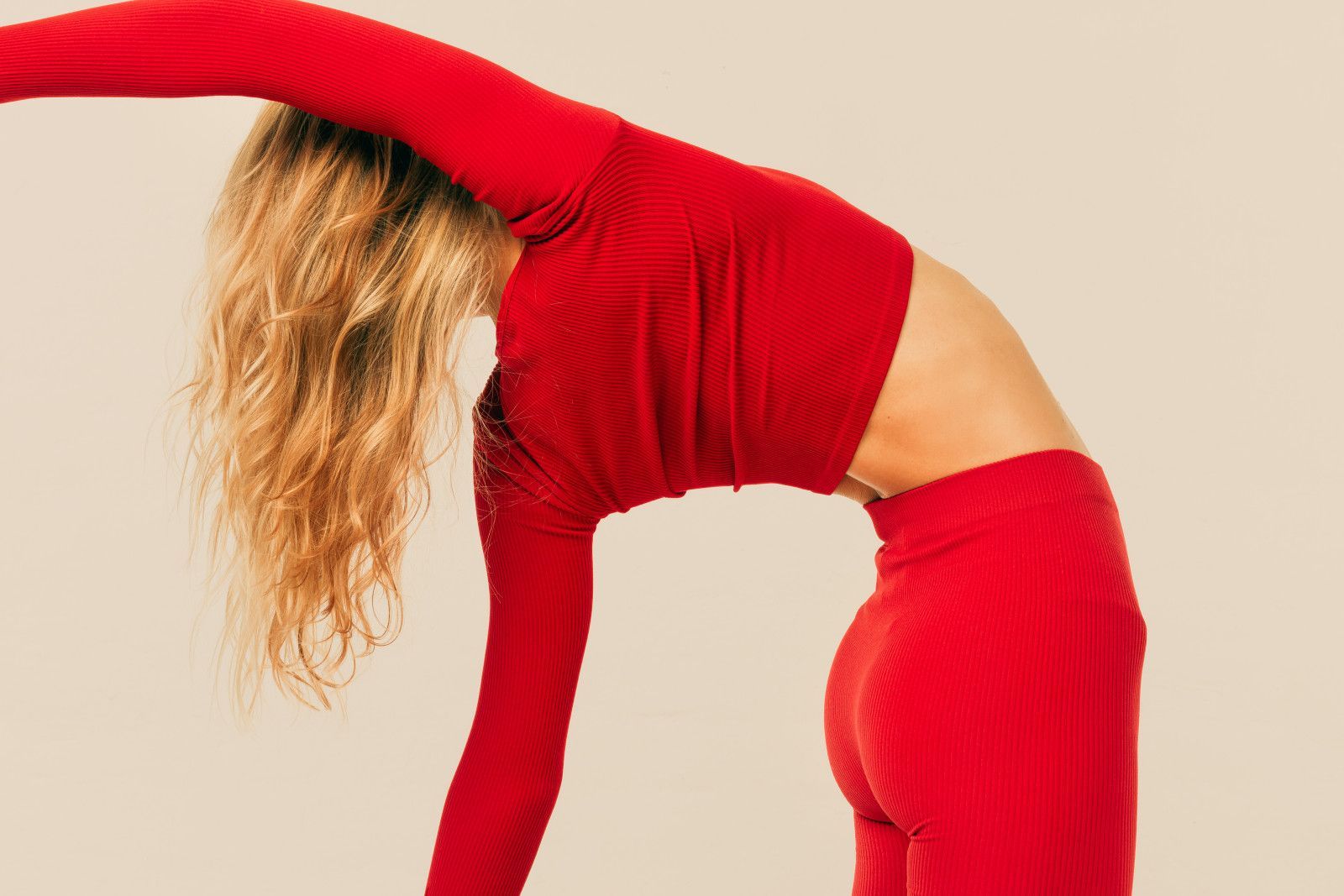
Somatic movement is movement done with attention turned inward. You are noticing sensation, weight, breath, effort, and ease as they happen, rather than tracking whether you are doing it right.
That inward turn changes the nature of the activity. The same gesture can be exercise or somatic movement depending on where your attention is. Rolling your shoulders while mentally drafting an email is one thing. Rolling them slowly enough to notice where the movement catches, where it feels smooth, and what happens in your breath as you move is another.
Somatic movement vs. exercise: why the internal experience is the point
Exercise usually has an external measure: distance, weight, repetitions, duration, how the shape looks. Those measures are useful, and I am not against them.
Somatic movement removes the measure. There is no target position, no count, no progress to chart. What replaces the measure is curiosity: what do I notice? What changes? What does this want to do next? And as I follow those signals and impulses, what begins to take shape? Is there a story here? A feeling? A need asking to be noticed?
This is harder than it sounds for people who are used to being good at things. When you take away the standard, a lot of people feel briefly lost, then bored, then something else entirely. That third thing is where the practice actually starts: when we stop monitoring ourselves so closely and lose track of whether we are doing it right, we can begin to actually inhabit the movement.
Somatic movement and yoga: similar shapes, different question
I love this topic, and I am asked about it constantly: what’s the difference? For the record, I’ve been practicing yoga for almost two decades, and I’ve taught it on and off for eight years.
You can absolutely practice yoga somatically, and many people do. The postures are not the issue. The question you are holding while you move is.
In a more form-oriented class, the implicit question may be whether your body is arriving at the pose. In a more contemplative or philosophically grounded class, there may already be a great deal of depth, inward attention, and invitation to notice what is happening within you. Somatic movement is not claiming ownership of that kind of listening. Its particular focus is on following what your body is telling you as it goes, including when it declines to go. If a shape does not want to happen today, that is information rather than failure.
The other difference is often the destination. Some yoga classes are structured around a sequence, a peak posture, or a particular quality of experience. Somatic movement is less interested in getting somewhere. It follows. Sometimes that leaves you more settled, and sometimes more activated. Neither outcome means the practice went well or badly.
What are examples of somatic movement?
People expect the examples to be exotic. They are mostly not. The range runs from movements nobody would notice to movements that need an empty room, and both ends are legitimate.
Small movements: a hand toward the chest, an urge to turn away, a shift in posture
A lot of somatic movement can be subtle enough to be nearly invisible.
Letting a hand come to rest on your sternum and staying there long enough to notice what that contact does. Noticing an impulse to turn your head away from something and letting the turn actually happen instead of overriding it. Slowly shifting your weight from one hip to the other and tracking what changes in your breath. Letting your jaw be as tense as it currently is, without trying to release it, and noticing what happens when you stop instructing it.
These sound almost too minor to matter. In my experience, some of the most meaningful shifts happen here, particularly for people who have spent years managing themselves. Small is not a compromise here. Small is often the size a guarded system can begin to trust.
Bigger movements: dance, sound, imagery, and leaving the chair
Then there is the larger end, which I love and which is not for everyone every day.
Standing up and pushing hard against a wall. Making a sound without deciding in advance what sound it will be. Letting your body move to music with nobody watching, including yourself—which I mean as moving without the internal camera running. Shaking. Reaching. Walking slowly around the room. Working with imagery until the image begins to change your posture on its own.
This end of the range can give strong feeling somewhere to go. Anger often needs more room than a chair allows. Grief sometimes does too, which can surprise people who imagine grief as only quiet.
How to tell which size you need today
There is no rule, but there is a useful question: does the bigger version feel like relief, or like performance?
If a larger movement feels like something your body is already leaning toward, follow it. If it feels like an assignment you are about to complete correctly, go smaller. The instinct to do the impressive version of a practice is often the same instinct that made the practice necessary.
Depleted days may call for smaller movement.
Charged days may want more range. Neither is more advanced than the other.

Do somatic movement practices release trauma?
Something real can happen in somatic work. People shake, cry, feel heat move through them, and afterward say that something loosened. I believe them. What I am more cautious about is the story we attach to those experiences.
Paying sustained attention to sensation can change how we relate to it. Slow movement, breathing, focused attention, and having another person stay present with us can all affect how an experience unfolds. None of that requires us to conclude that a traumatic memory was literally stored in a muscle and then released from it.
This distinction matters because interpretation can become powerful very quickly. If a person is shaky, emotionally open, and trusting you, telling them that a sensation or movement is evidence of an event they do not remember can cross into suggestion.
Psychology has a long and difficult history with recovered-memory practices, in part because memory is reconstructive and can be influenced by what we are told and what we expect to find.
I am also wary of explanations that cannot really be disproven. Shaking means release. Not shaking means you are armored. Symptoms returning means there is another layer. When every possible outcome confirms the theory, it becomes difficult to tell the difference between a useful metaphor and a factual claim about how memory works.
So I think it helps to keep two claims separate. Somatic work may help with trauma symptoms is a reasonable thing to say. Somatic work releases trauma stored in the body makes a much more specific claim about mechanism, and the evidence for that claim is far less clear.
A good practitioner should be able to describe what they are doing without turning your body into a decoder ring. The work can still be meaningful without pretending that every tremor, posture, or sensation is a buried memory announcing itself.
What I can say honestly: what tends to shift, and what I won't claim for you
Here is what I will say. People who practice somatic movement over time often report more room around difficult experiences, more choice within them, and more trust that they can move through something without being flattened by it. Long-held tension patterns sometimes shift. Emotional range can widen. Creative work can open back up.
Here is what I will not say. I will not tell you that a specific movement removes a specific trauma. I will not interpret your body’s signals as proof of an event. I will not promise that a practice, done consistently enough, will resolve what you are carrying on a predictable schedule.
If you experience something as a release, I will absolutely call it that with you. The word is yours to use. My objection is to someone else assigning the meaning before you have had a chance to find it for yourself.
Can I practice somatic movement at home, and how often?
Yes, and I would encourage it, with one adjustment to how you are probably thinking about it.
How you practice matters more than how long
Two minutes of genuinely noticing what happens as or after you move can be more useful than thirty minutes spent monitoring whether the practice is working. For many people, brief and frequent is easier to sustain than long and scheduled.
A reasonable starting point is a few minutes on most days, ideally at a time when you are not already depleted. Begin with something small and specific. Let your attention follow rather than direct.
If you want a concrete way in, try this. Stand or sit, and let one arm rise as slowly as feels tolerable. Not slowly because you are trying to perform slowness correctly, but slowly enough that you can notice where the movement stops feeling smooth. Notice what your breath does. Notice the impulse to speed up and finish. You do not have to obey it, and you do not have to resist it either.
That whole thing can take ninety seconds! It counts.
When to do this with support instead of alone
If turning attention inward consistently brings on flooding, panic, or dissociation, that is a sign to do this with support rather than alone. That is not a personal failing. It is information about what your system can comfortably stay with right now, and that can change over time. Working with someone is a different arrangement entirely, and my overview of somatic therapy explains what changes when another person is in the room.
And if the practice has become one more item you are failing to complete correctly, stop for a while. A practice that has turned into self-surveillance is working against its own purpose. I would rather you take a month off than add somatic movement to the list of things you are behind on.
What does somatic movement offer when words stop being enough?
Some experiences do not organize into language, or not yet.
Grief is the clearest example. People come to me able to narrate a loss with complete accuracy and still feel no real relief. They have told the story many times. The telling has stopped doing much. That is often the point where movement becomes useful, because it does not require the experience to be already understood in order to give it somewhere to go.
Ambiguous loss works this way too. The losses without a funeral: a relationship that changed shape, a body that no longer does what it did, a version of your future that quietly stopped being available, a person still living who is no longer reachable. Those griefs are hard to talk about partly because language keeps asking you to justify calling them grief. Movement does not ask for the justification.
This is a large part of my grief therapy work, and it is why I rarely start there with words. The goal is to stop having to hold it entirely in your head, not necessarily to move through it faster.
What this looks like when grief is the reason you came
It usually starts smaller than people expect.
Often the first thing we find is not grief itself but the effort of containing it: a held breath, a set jaw, a chest that has been braced for months. We stay with the containing rather than trying to get underneath it, because the bracing is doing a job and it deserves to be understood before it is asked to change.
What may shift first is not the intensity of the loss. It is how alone you are with it inside your own body.
That is a smaller claim than the internet often makes, and in my experience it is the one that actually holds.
What could somatic movement give somewhere to go?
You already know a lot about yourself. That knowledge is not the problem, and it is not going to waste. It may have simply reached the edge of what understanding alone can change, and some part of you noticed that a while ago.
What I offer is a space where you do not have to explain first. Where a movement can happen before you know what it means, and where nobody, including me, is going to hand you an interpretation you did not arrive at yourself. I work with adults navigating trauma, chronic illness, transition, and grief that has not followed anybody's timeline, using movement and creative practice alongside conversation.
My practice is in Santa Monica for in person sessions, and I also see clients virtually across California, including people in Mar Vista and Playa Vista who want to work from a room where they already feel able to move.

Hi! We are Vida Collective Counseling
Vida Collective is a therapy practice that supports women in slowing down, feeling supported, and reconnecting with themselves in a grounded, compassionate space.