
What is somatic therapy? And how movement helps regulate your nervous system
Most people who find their way to this question are not short on self-knowledge. You can name your attachment style. You know which part of your history shaped which reaction. You have language for all of it. And still, in the moment, your jaw tightens, your breath goes shallow, and you handle it, the way you always have.
Somatic therapy starts somewhere else. Instead of beginning with the story and working toward the body, it begins with what is actually happening in you right now, and lets meaning arrive later, if it arrives at all. That shift sounds small. In practice it changes almost everything about how a session feels.
Below, I want to walk you through what somatic therapy actually is, what happens in a room, what movement has to do with your nervous system, and where the honest limits of this work are.
In case you’re new here, I’m Danielle Wiggins. My work is rooted in somatic psychotherapy, and I support thoughtful adults who have done years of inner work and still feel braced, distant, or half a step ahead of themselves. My approach is relational, trauma-informed, and slower than most people expect. I am not here to get your nervous system into a particular state. I am here to help you build a relationship with it that you can trust.
What is somatic therapy?
Somatic therapy is psychotherapy that treats bodily experience as part of the conversation rather than a side effect of it. Sensation, breath, posture, gesture, impulse, and movement all get to participate. So do thoughts, memories, relationships, and everything else you would bring to any other kind of therapy. The body is not a replacement for talking. It is an addition to it, and often the part that has been missing.
The reason this matters is simple. Most of the people I work with are not short on insight. They have read the books, listened to the podcasts, and done previous rounds of therapy. They can explain themselves with unusual precision. What they describe, over and over, is a gap between understanding something and being able to live differently with it. Somatic work lives in that gap.
A metaphor I like to use with clients is that there’s a difference between knowing a walk in nature will make you feel good and actually taking your body on that walk. You find the tree, feel the texture of the bark, hear the sounds around you, notice the smells and the colors. You experience the felt sense of being there. That’s a whole different kind of knowing.
Actually inhabiting an experience, again and again, can be medicine. Talking about why something might be healing is a start. But there’s a whole other world of letting the body experience it.
Somatic therapy vs. talk therapy
In a lot of talk therapy, the movement is from event to interpretation. Something happened, we make sense of it, and the sense we make is supposed to loosen its hold. That works more often than people give it credit for.
In somatic therapy, we might start from the fact that your shoulders climbed toward your ears the moment you began telling me about a particular conversation. We slow down there. Not to interpret it, and not to fix it, but to stay with it long enough to see what it does next. Sometimes it softens. Sometimes it gets stronger. Sometimes an image arrives, or a sentence you didn’t know you were carrying, or an urge to push something away with your hands.
The pace can be different, too. Talk therapy can cover a lot of ground in fifty minutes. Somatic work often covers very little ground, very slowly, and that slowness is the point. We’re not asking your nervous system to reorganize through understanding something in a short amount of time. We tend to it through repetition, relationship, and time.
The word somatic: treating the body as information, not proof
Somatic comes from the Greek word for body, soma. In this work, it refers especially to the body as it is experienced from the inside. Not the body as an object you evaluate in a mirror, but the body you are living in as you read this.
Here is where I part ways with a lot of what gets published about this work. There is a popular version of somatic therapy that treats the body as a decoder ring. Your hips are holding grief. Tight shoulders mean you carry too much. Shaking means a specific trauma just left you. I understand the appeal. Certainty feels like relief when you have been confused for a long time.
But I do not want to tell you what your body means before we have actually listened to it. Sensation is information worth exploring, not evidence of a conclusion I have already reached. When a client tells me their chest feels tight, my first question is not what that symbolizes. It is what happens if we stay with it, what shifts, what wants to move, what becomes possible afterward. The meaning, when it comes, tends to come from them.
What do we do during somatic therapy?
Most sessions look like a conversation with pauses in it. We talk. Something lands. I might ask you to notice what happened in your body just then, or where you feel most settled right now, or whether there is an impulse you are talking yourself out of. You answer, or you do not know, and we sit with not knowing for a minute, which can be more useful than rushing toward an answer.
What a first session usually looks like
People are often braced for a first session to be intense, so it is worth saying plainly that it usually is not.
We start with what brought you here, in whatever order it comes out. I am listening to the content, and I am also noticing pacing: where you speed up, where you flatten out, where you check my face to see how it is landing. None of that gets named as a verdict about you. It is just early information about how your system organizes itself in a new relationship.
Somewhere in there I will probably ask a small question about sensation. Not because sensation is the point of the first hour, but because I want to find out what happens when attention turns inward. Some people find something immediately. Some people find nothing and feel a flicker of failure about that. Finding nothing is a completely workable starting place, and it is far more common than the internet suggests.
We also cover the practical scaffolding: what stopping looks like, how often we might meet, what you want to be different. You do not need to arrive with a clear goal. Wanting the inside of your life to feel less effortful is enough of a place to begin.
Examples of somatic therapy: what a session can include
Tracking sensation is the baseline. That means noticing temperature, pressure, tension, movement, and stillness as they change, without immediately deciding what any of it means.
Orienting is another. Looking around the room, letting your eyes land where they want, noticing that you are here and it is now. It sounds almost too simple to matter. For a system that has been scanning for threat, it can be a genuine relief.
We might work with pacing, which means going toward something difficult in small amounts and then coming back out, rather than diving in and hoping you can swim. We might work with resourcing, which means finding a place in your body or your life that feels even slightly more settled and letting your attention rest there before we go further.
And we might work with movement, which can be as small as letting a hand travel toward your own chest or as big as standing up, pushing against a wall, making sound, or moving something that has no words yet. My background is in movement, so this door is always open. It is never required.
Touch and consent: what to expect and what to ask before you start
People ask whether a somatic therapist touches you. It is a fair question and you should ask it directly of anyone you are considering working with.
Some somatic practitioners do use touch, always with explicit consent, and there are frameworks that train for it carefully. My own work does not center on physical touch. What it does center on is your right to say no, to change your mind mid-session, to stop something that is happening in your own body, and to have that treated as useful information rather than resistance.
If a practitioner cannot answer questions about consent, scope of practice, and what happens if you want to stop, that tells you something worth knowing before you book.

How does movement help regulate your nervous system?
Movement was my first language long before it was part of my clinical work. Dance, being outside, moving without having to explain myself. Later, chronic illness and grief taught me something I could not think my way around, which is that my body was participating in my life whether I invited it into the room or not.
Movement helps because it gives a charged system somewhere to go. When you have been holding a lot, stillness is not always soothing. Lying down can make sensation louder, not quieter. Movement offers another route in: rhythm, pressure, weight, breath, and a pace your system can actually follow.
Regulation is not calm: what a regulated response can look like
This is the belief my whole practice hangs on, so I want to be direct about it. Regulation does not mean calm.
Somewhere along the way, regulated started to mean unbothered, grounded, sleeping well, breathing deeply, never overwhelmed. I do not think that holds up to a real life. Grief disrupts people. Illness disrupts people. Falling in love disrupts people. The world disrupts people. I do not want anyone measuring their healing by how little they are affected by being alive.
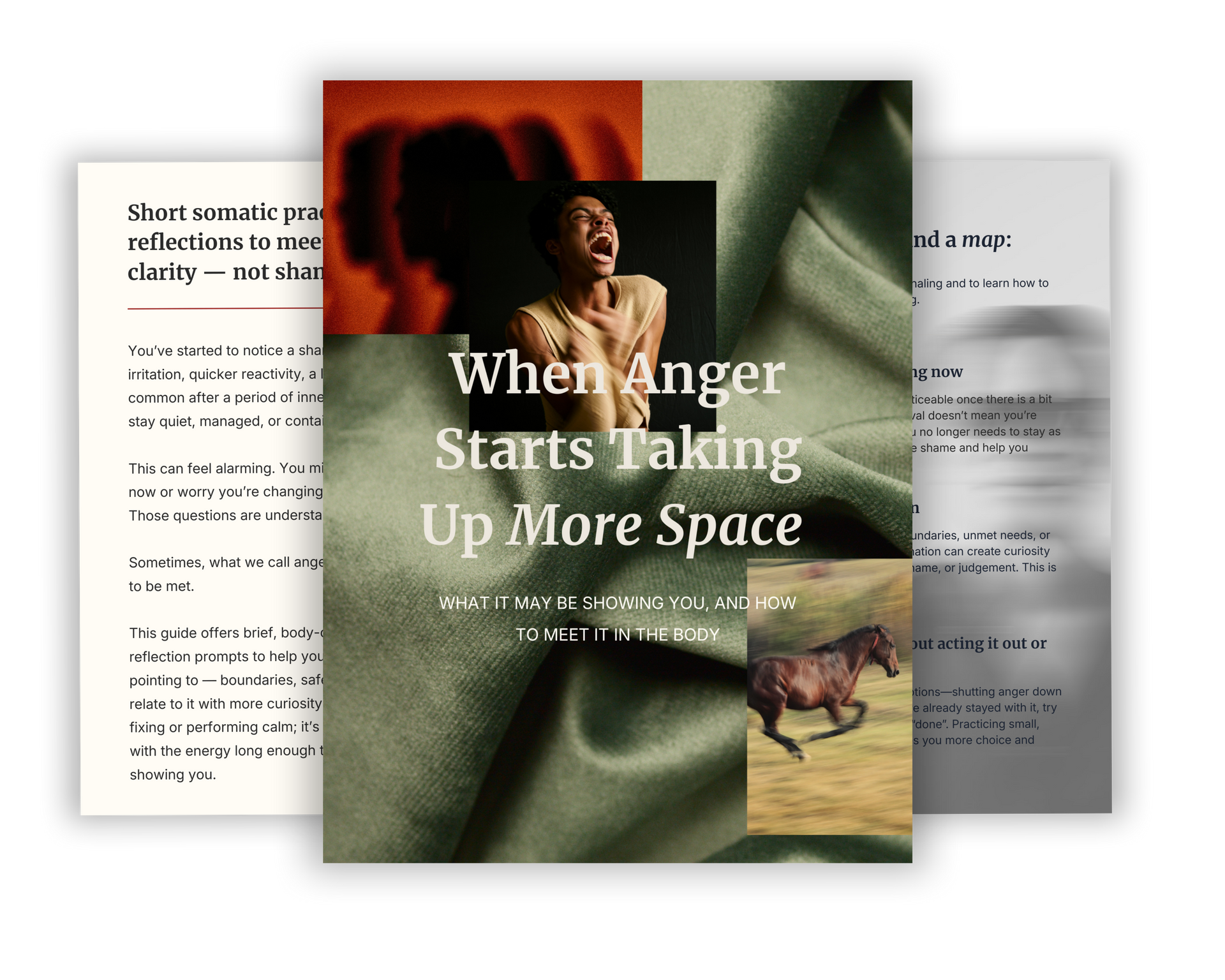
What I am actually building with clients is capacity. The capacity to notice what is happening, to stay in relationship with yourself while it happens, and to have more choice about what you do next. A regulated response can look like rest and softening. It can also look like anger, movement, tears, saying no, taking up space, or becoming far more expressive than you have let yourself be. Regulation is not becoming impossible to disturb. It is having more capacity to stay with yourself when you are.
Somatic therapy exercises
There is no shortage of somatic therapy exercises online, and some of them are genuinely useful. Slow exhales. Feeling your feet. Gentle shaking. Orienting the room.
What I have noticed over the last couple of years is that the people arriving in my practice are not short on techniques. They are exhausted by them. They have a folder of practices and a running internal commentary asking whether they are regulated yet, whether this is a trauma response, whether they are doing the exercise correctly. The language of nervous system work has quietly become another way to monitor and manage yourself.
So I am careful about handing out protocols. Not because practices do not help, but because a practice you are performing correctly while watching yourself from the outside is not the same as being inside your own experience. What I want for you is fewer instructions and more room.
Is somatic therapy legitimate and evidence-based?
Body-based approaches to survival responses and post-traumatic stress have been studied, and there is meaningful evidence for several of them. That research is part of why trauma therapy is where somatic work has taken hold most firmly. There is also a great deal of confident language in the wellness world that runs well ahead of what any study has shown. Both things are true at once, and I would rather you know that than be sold certainty.
What I can tell you from inside the work is narrower and more useful. People who have understood their patterns for years often report that something finally moves when the body is included. Not because insight was wrong, but because insight was never going to be enough on its own.
Criticisms worth taking seriously: certainty, overreach, and hype
A few criticisms of somatic therapy are worth holding onto rather than defending against.
The first is overclaiming. When practitioners describe exactly what your body is holding and exactly what a tremor means, they have left observation behind and entered storytelling. That is not harmless. It can teach you to outsource the interpretation of your own experience. A therapist can point, notice, and help you stay with what is there. They should not drive the meaning for you.
The second is that focusing intently on sensation can be genuinely destabilizing for some people, particularly with complex trauma. Pacing is not a stylistic preference in this work. It is a safety practice.
The third is that somatic language sometimes gets used to explain physical symptoms that deserve medical attention. Your body is not only a psychological text. Sometimes something hurts because something hurts.
Can I do somatic therapy on myself?
Partly. It is worth separating what genuinely works alone from what tends to need another person, because the honest answer is different for each.
What you can genuinely do alone
You can build a real relationship with your own body without a therapist in the room. People do it through movement, breath, time outside, creative practice, and simple attention. That is not a consolation prize. It counts, and for many people it is the thing that keeps them tethered between sessions.
What tends to work on your own is small, frequent, and low stakes. A few minutes of noticing what your weight does when you stop bracing against the floor. Letting a stretch happen at the speed your body actually wants rather than the speed you scheduled. Going for a walk without a podcast in your ears. Practices this small and ordinary can often be explored on your own.
What tends to need another person
The relational part is harder to replicate. A great deal of what shapes a nervous system happened in relationship, often early, often without words. Being met by another person while something difficult moves through you is not a nice extra. For many people it is the active ingredient.
There is also a practical limit. When you are working alone, you are both the person having the experience and the person watching to see whether something is shifting. That double role is exhausting, and it is exactly the pattern many people are trying to step out of. Part of my job is holding enough of the structure that you can stop supervising yourself for fifty minutes.
And if turning attention inward repeatedly brings on panic, numbness, or losing time, that is a clear signal to do this with support rather than alone. That is information about capacity, not a verdict about you. Capacity can grow when you do not have to hold the whole experience by yourself.
What if somatic therapy isn't one more thing to get right?
You have spent a long time understanding yourself. You have been thorough, and honest, and probably harder on yourself than you would ever be on a friend. If you are here reading about somatic therapy, my guess is that you are not looking for another framework to master. You are tired of managing yourself, and you would like to inhabit your life instead.
That is the work I do. I support adults navigating trauma and the long habits of survival, along with grief, ambiguous loss, chronic illness, and the transitions that ask you to change faster than your body can. Together we slow down, track what is actually here, and make enough room for something honest to move. Not on a schedule. Not toward a permanently regulated state. Toward a version of you that can be complicated and still stay in relationship with yourself.
My practice is based in Santa Monica, where I see clients in person. I also work virtually with people across California, including adults in Venice and Marina del Rey who would rather begin from their own space than sit in traffic before a session.

Hi! We are Vida Collective Counseling
Vida Collective is a therapy practice that supports women in slowing down, feeling supported, and reconnecting with themselves in a grounded, compassionate space.